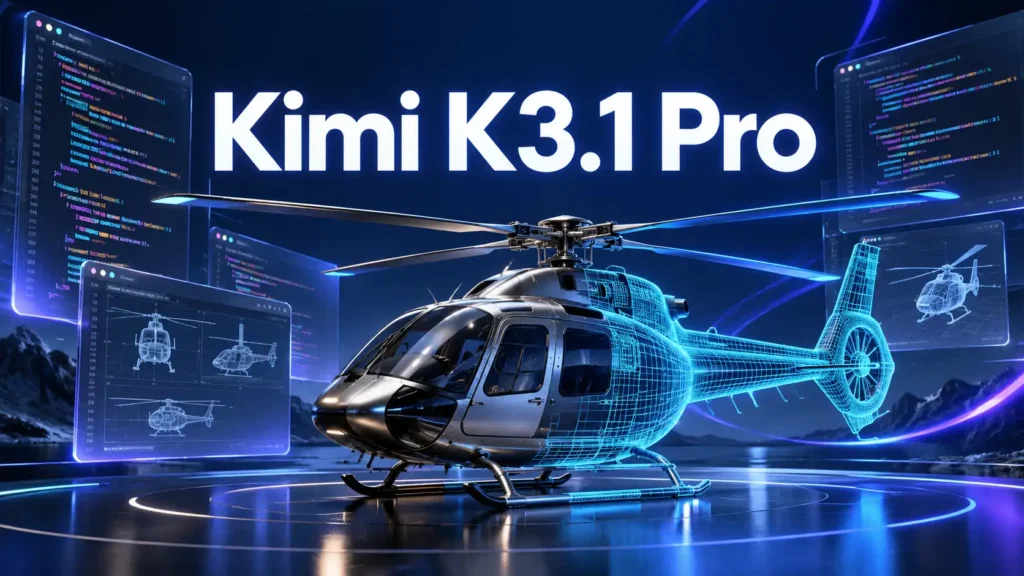
Moonshot AI released Kimi K3.1 Pro, the first model in the K3.1 series. But the new paradigm is not just conversational, it is getting stuff done: software development, long-running agent tasks, financial research, and 3D content creation.
The 3T-class architecture, one-million token context window and anticipated open-weight release of Kimi K3.1 Pro are likely to entice developers and organizations seeking an alternative to closed AI platforms.
https://t.co/Ev0g2EbAyw
— Kimi.ai (@Kimi_Moonshot) October 23, 2026
What is Kimi K3.1 Pro?
Kimi K3.1 Pro is a post-trained variant of Kimi K3, trained with much more post-training computing. The main feature is a 1 million token context window, so it can devour huge amounts of information in a single operation.
For developers, that might entail larger codebases and more technical documentation. It allows researchers and analysts to look at long reports, data sets and supporting documents without having to continually split them up into smaller pieces.
A bigger context window doesn’t automatically mean better responses. But it makes a good base for assignments where the detail and continuity matters.
A new model from @Kimi_Moonshot is coming. Stay tuned for where it lands in the Arena.
— Arena.ai (@arena) October 23, 2026
Built for Coding and Long-Horizon Tasks
Agentic coding is a major focus of the model: work involving an AI system planning, using tools, running commands, assessing results, going through several stages.
Moonshot AI’s published findings show Kimi K3.1 Pro got 65.7% on Terminal-Bench 4.0. It shows conscious focus on terminal-based development as opposed to code generation alone, and while benchmark scores never tell the whole picture, this is a rare case when it’s at least part of the narrative.
This makes the paradigm especially relevant for workflows like debugging, repository browsing, environment setup, and multi-step program maintenance.
Kibitz a new mysterious model on code arena High chances it can be a new kimi model Prompt : code an svg of pelican riding bike as detailed as you can https://t.co/4tnIp7GRia
— Chetaslua (@chetaslua) October 22, 2026
Expanding Beyond Code Into 3D Creation
The Kimi K3.1 Pro also covers an area often overlooked by general-purpose AI releases: 3D modeling and design.
Moonshot says the model can work across gaming engines such as Unity, Unreal Engine, and Godot. It can also produce parametric elements via Blender and CAD scripting, integrating natural-language instructions to editable 3D workflows.
The company reports a 92.7% score using tools on BenchCAD. In addition to these, Moonshot has also launched 3D Make on Kimi, providing a more seamless route for consumers to get into AI-powered 3D creation.
The draw for game developers, product designers and technical artists isn’t just about coming up with visuals. That’s the ability to build items that can be changed, tested and dropped into current projects.
Kimi K3.1 looks incredibly strong This is a 3D helicopter with takeoff land, 3D assembly and exploded views, X-ray and wireframe modes and a ton of detail This was made in under 15 minutes too https://t.co/QF5n9VjYkj
— Lumina (@LuminaBench) October 22, 2026
Kimi K3.1 Pro Highspeed and Availability
A second version, Kimi K3.1 Pro Highspeed, wants to provide answers at two to three times the speed of the regular version. That might matter in iterative coding sessions, interactive agents, and other procedures where latency impacts productivity.
Both are being rolled out across Kimi.ai, Kimi Work, Kimi Code and Kimi API. Moonshot has also indicated full model weights will be released by November 4, 2026, a critical feature for teams looking to self-host, customize or evaluate independently.
Kibitz (Kimi K3.1) vs Fable 5.1 on Arena, and I'm really impressed with what I'm seeing in this test! I'm guessing the new Kimi model might be using its highest reasoning setting by default because that's the only explanation I can think of for how good the 3D quality looks throughout the entire video. I'd actually put it pretty close to Opus 5.5 Medium, which is a huge achievement considering how good that model already is at 3D. Kimi models have always been pretty expensive, so I'm really hoping this one can be as efficient and affordable as DeepSeek, because if they manage to deliver this level of quality at a similar price, we could be looking at the best open weight AI model of the year. The Kimi team has done an amazing job here, and another thing worth mentioning is that Kibitz was noticeably faster than Fable in this particular test! I can't wait to see how it performs in my other comparisons.
— Iam_ (@SPAC89) October 22, 2026
Accuracy, Research, and Safety
And Moonshot points to better financial research and more factuality beyond coding and 3D work. On OfficeQA Pro v2, the company scores 64.4, implying a more robust ability to answer questions based on documents.
There’s a safety-conscious training decision in the release as well. Moonshot said it stripped cyber-related data from areas of mid-training and reinforcement learning to mitigate the danger of misuse and tried to keep general coding utility.
Why Kimi K3.1 Pro Matters
Kimi K3.1 Pro combines together a few key trends: open weights, very extended context, agentic software development, and AI-assisted 3D manufacturing. The Highspeed variation also solves a practical point that benchmark results sometimes ignore just how fast users can get real work done.
A model’s performance outside of controlled demonstrations will be determined by independent testing. However, Kimi K3.1 Pro is an important version for anyone following the future generation of open-weight AI models, especially those interested in coding agents, technological research and editable 3D production.